


DAY ONE: 11:47 AM
The first thing Dr. Maya Santos noticed was the smell.
Not the antiseptic clinic smell she’d lived with for three years. Not the coconut sunscreen and salt water that usually drifted through her examination room. This was different. Marine. Ancient. Like the bottom of the ocean had burped up something that should have stayed buried.
Trevor Walsh lay on the examination table, twenty-six years old, Australian, athletic build going soft around the edges from resort living. His girlfriend stood in the corner, bikini still damp, mascara running. Both of them stank like low tide and rotting kelp.
“How long has he been like this?” Maya asked, snapping on gloves.
“Since around noon. Maybe earlier. We were snorkeling this morning. He cut his foot on coral. Nothing serious.”
Maya looked at Trevor’s foot. The cut was small, already scabbed over. But the skin around it was wrong. Gray-blue, like meat from a deep freezer. And spreading. The discoloration crept up his ankle in branching patterns that looked less like infection and more like something growing inside him.
“Trevor, I need you to breathe for me.”
He tried. The breath caught, turned wet, became a cough that sprayed pink foam across his lips. The foam smelled like brine and something chemical. Ammonia mixed with iodine mixed with something sweet that made Maya’s mouth water against her will. Her body wanted to taste it. Wanted to swallow it. The compulsion was immediate and wrong.
She placed her stethoscope against his back.
What she heard made her pull back like she’d touched fire.
Normal lungs were whisper-quiet, the soft rush of air through millions of tiny sacs. Trevor’s lungs sounded like he was drowning, but worse. Wet crackling, fluid sloshing with each breath. And underneath, a clicking. Rapid, coordinated, like dozens of tiny joints snapping in rhythm. Cicada-like but wetter. Bone on bone through liquid.
Not drowning. Restructuring.
“It hurts,” Trevor gasped. “Feels like something’s building in my chest. Like pressure. Like I need to get underwater.”
Maya peeled back the bandage on his foot. The wound had closed over with impossible speed, but the skin was translucent now. She could see through it. Underneath, dark threadlike shapes moved through his capillaries, pulsing with coordinated rhythm. They branched and merged, following his circulatory system with terrible purpose.
She grabbed her penlight, leaned close. The threads were segmented. Each segment maybe half a millimeter long, with tiny hooks along the sides. Hundreds of them. Maybe thousands. All moving upstream, heading toward his heart, his brain, his lungs.
Parasites. Had to be. But nothing moved this fast. Nothing caused this kind of restructuring within hours of exposure.
Maya pulled off her gloves, went to her office, grabbed her satellite phone. Dialed Manila General Hospital. Busy signal. Tried the regional clinic in Cebu. Same.
Thunder rolled across the lagoon. The storm was six hours out according to this morning’s report. Category 2, maybe Category 3 by landfall. The island would be cut off for three days minimum.
She walked back to the examination room and stopped in the doorway.
Trevor had sat up. The blankets had fallen away. His hands were pressed flat on the table, fingers spread wide. Between each finger, thin membranes of skin stretched like webbing. Not swollen tissue. Actual webbing. Translucent, delicate, with tiny blood vessels visible through the membrane like spider silk made of flesh.
He flexed his hands experimentally. The webbing pulled taut with a sound like wet leather stretching. His face showed wonder, not horror.
“I can feel it,” he whispered. “In my throat. In my chest. It’s building something. And it feels... right. Like I was incomplete before and now I’m becoming what I was supposed to be.”
The smell intensified. That low-tide reek. Maya saw moisture beading on Trevor’s skin. Not sweat. Something thicker. More viscous. It smelled like seawater and decay and something else. Something sweet. Like overripe fruit mixed with brine. The smell made her dizzy. Made her think about water. About diving deep and never coming up.
Trevor stood. The girlfriend backed toward the door, making small sounds of fear. Trevor didn’t look at her. His gaze fixed on the window, on the lagoon beyond, with intensity that was no longer quite human.
“Trevor, sit down,” Maya commanded. “You’re not well. We need to establish IV access, start antiparasitics, get you stabilized before”
He walked past her. Out of the clinic. Barefoot across the wooden deck, moving with steady purpose. Maya followed, the girlfriend behind her, both of them shouting his name.
Trevor reached the beach. Kept walking. The water was crystal clear, blue-green, beautiful. He walked into it like coming home. When it reached his waist, Maya saw his back muscles shifting under the skin. Reorganizing. His shoulders broadening. His neck thickening with structures that pushed against the skin from inside like fists under a sheet.
Gills.
Christ. He was growing gills.
The water reached his chest. Trevor submerged. No hesitation. No struggle. Just disappeared beneath the surface with barely a ripple.
Maya stood at the waterline, heart hammering. Thirty seconds. A minute. Two minutes. Three.
He didn’t surface.
“He’s drowning!” the girlfriend screamed. “We have to”
“No.” Maya grabbed her arm. “Don’t go in. Don’t let anyone go in the water.”
“But he’s dying!”
“He’s breathing,” Maya said quietly. “He’s underwater and he’s breathing and if I’m right about what I just saw, he’s not alone down there.”
She looked out at the lagoon. The water had a faint shimmer to it now that she hadn’t noticed before. Iridescent. Oily. And it tasted sweet. Maya realized with horror that spray from the waves had gotten into her mouth. She could taste it. Sweet and chemical and wrong. Her body wanted more.
In the distance, maybe thirty meters from shore, something broke the surface. A head. Human-shaped but wrong. Larger eyes, wider mouth, skin that gleamed gray-blue in the afternoon light. It looked at her for a long moment. Then it submerged again, leaving only ripples.
One of the other guests, she realized. Someone who’d been infected days ago. Before anyone knew the lagoon was contaminated. Before anyone understood what lived in the water.
Maya ran for the main lodge.
DAY ONE: 2:15 PM
Javier Reyes was ex-Philippine Navy, fifteen years in special operations before retiring to run the resort. He’d seen combat in the Sulu Sea, cleared pirate nests, pulled bodies from capsized ferries. He didn’t panic easily.
But when Maya told him what she’d just watched, his face went pale.
“You’re saying he grew gills. In less than three hours.”
“I watched his body restructure in real-time. Parasite’s rewriting human biology at the cellular level.”
“What kind of parasite does that?”
“I don’t know. But it’s waterborne. Enters through broken skin. Complete metamorphosis in six to eight hours from initial exposure.”
Javier looked out the window. The lagoon stretched below, deceptively peaceful. Guests were still swimming. A family of four playing on inflatable tubes. An elderly couple snorkeling near the reef. Three teenagers doing backflips off the dock.
“How many people were in the water today?”
“Activity log says twenty-three signed out snorkel gear. Could be forty total.”
Javier grabbed his radio. “Security, get everyone out of the water. Now. Sound the emergency bell. I want all guests and staff in the main lodge within ten minutes.”
Static. Then nothing.
“Comms are already failing,” he said. “Storm interference.”
“Do it manually. Once people start showing symptoms, they’ll seek water instinctively. The compulsion is overwhelming.”
Javier nodded, already moving. He grabbed his assistant manager, sent runners to every villa. The bell started ringing, long and urgent. Within minutes, confused guests were appearing on balconies, wrapping towels around wet swimsuits.
Maya stood on the lodge’s second-floor balcony, counting heads as people filed in. Fifty total. Thirty-four guests, sixteen staff. She tried to remember who’d been in the water, who’d come to her for coral cuts or jellyfish stings in the last week.
Too many. Far too many.
She saw the family of four from the inflatable tubes. The Hargrove family from Sydney. Parents in their forties, two daughters. Emma, the youngest, maybe eight years old, was scratching at her elbow. Even from this distance, Maya could see the gray-blue tint spreading from a scrape.
Six hours, she thought. Maybe less.
The sky was darkening fast. The storm was ahead of schedule.
DAY ONE: 4:30 PM
Maya stood on the small stage in the dining room, microphone in hand, looking at fifty terrified faces.
“There’s been a contamination incident in the lagoon,” she said, keeping her voice level. “An unknown parasitic organism. Waterborne. We believe it enters through cuts or abrasions. Once inside, it causes rapid physiological changes.”
“What kind of changes?” someone called out. Australian accent. Male, forty-something, the kind who introduces himself by mentioning he’s a litigation attorney.
Maya chose her words carefully. “Adaptation for aquatic environments. Respiratory restructuring. Behavioral modification. The affected individual will seek water and may attempt to submerge.”
“You’re saying people turn into fish?” Nervous laughter from the back.
“I watched a man develop functional gills and breathe underwater for over three minutes. The parasite is real, it’s fast, and it’s in the lagoon. Anyone who’s been swimming today needs to report any symptoms immediately.”
The laughter died.
“The storm will keep us isolated for three days,” Javier added. “After that, we evacuate everyone. But until then, nobody goes near the water. Dr. Santos will do individual screenings.”
“What about the people already infected?” A woman’s voice. Shaking. “Can you cure them?”
Maya met their eyes. Twenty years of practice at delivering bad news. “I don’t know. I’ve never seen anything like this. Standard antiparasitics won’t work at this stage of integration. We’re in uncharted territory.”
Silence. Heavy and suffocating.
“Everyone who entered the water today, come see me,” Maya said. “Now.”
DAY ONE: 6:45 PM
Maya had converted the conference room into a triage station. Twenty-three people filed through. She checked every scrape, every cut, every coral abrasion. Shined her penlight through skin, looking for those dark threading lines.
Six showed early signs.
One was Emma Hargrove.
The girl sat on the examination table, legs swinging, while her mother held her hand. The scrape on her elbow was healing over with that same translucent skin. Under it, Maya could see the threads moving. Branching. Multiplying.
“How do you feel, Emma?”
“Weird,” the girl said. “Like I’m breathing wrong. Like the air is too thin. And I’m thirsty but water doesn’t help. I need... something else.”
“She’s been asking to go swimming,” the mother said. “She keeps saying she feels like she’s suffocating in here.”
Maya checked Emma’s lungs. The clicking was faint but present. The restructuring had begun.
“Mrs. Hargrove, I need to be honest. The parasite is already in Emma’s bloodstream. It’s migrating toward her respiratory system. Within a few hours, possibly less, she’ll begin developing aquatic adaptations. Gills, webbing, altered skin. The compulsion to seek water will become overwhelming.”
“Can you stop it?”
“I don’t know. I can try antiparasitics, but they’re designed for specific life stages. This thing is already integrating at the cellular level. Killing it might kill the host.”
The mother started crying. Quiet, desperate. Maya had seen that look before. Parents watching their children die from diseases with no names and no cures.
“I need to quarantine everyone showing symptoms,” Maya said. “Conference room A locks from the outside. I’ll make them as comfortable as possible. Monitor their progression. Maybe if I understand the transformation process, I can find an intervention point.”
“What happens when she completes the change?”
Maya looked at Emma. The girl was staring at the window, at the rain now lashing the glass, with an expression of terrible longing.
“I don’t know if she’ll still be your daughter,” Maya said quietly. “Or something else wearing her face.”
DAY ONE: 8:00 PM
Six infected quarantined in conference room A. All in early stages. Skin discoloration spreading. Respiratory distress increasing. The clicking in their lungs getting louder.
Maya set up monitors. IV lines. Drew blood samples she couldn’t properly analyze without a real lab. She was a field doctor, good at improvisation, but this was beyond anything she’d trained for.
The parasite looked like a flatworm under her microscope. Segmented body, maybe two millimeters long in its larval stage, with rows of tiny hooks along its sides. Those hooks were how it anchored to blood vessel walls. How it pulled itself upstream toward major organs.
But there was something else. Every few minutes, the parasites in the blood sample would pulse in unison. All of them, perfectly synchronized. Chemical communication, she thought. Or something stranger. Quantum entanglement? Collective intelligence?
She was watching the sample when one of the infected started screaming.
It was David, the American teenager. Seventeen years old, football scholarship waiting back home. His parents had brought him here for a vacation before college. Now he was strapped to a chair, clawing at his throat, face purple.
“Something’s wrong,” his father shouted through the glass. “He can’t breathe!”
Maya ran in. David’s airway was clear but he was suffocating anyway. His gills were forming, slits opening along his neck, but they weren’t functional yet. The tissue was raw, bleeding, torn edges exposing cartilage underneath. He couldn’t breathe air and couldn’t breathe water. Trapped between states.
She grabbed a spray bottle, filled it with tap water, misted his throat. The emerging gills flexed, trying to filter oxygen. It wasn’t enough. His lips were turning blue.
“Bathroom,” Maya said. “Now.”
They half-carried, half-dragged him to the adjoining bathroom. Filled the sink. Maya pushed David’s face under. He struggled for a second, then went still. His gills flexed fully, filtering the water with wet clicking sounds. His color returned.
He was breathing. Underwater. Just like Trevor.
Maya pulled him up after thirty seconds. David gasped, coughed, sucked in air. But his face was already turning purple again.
“He needs to be submerged,” his mother said, voice breaking. “That’s what you’re saying. He needs water or he’ll suffocate.”
“The transformation isn’t complete,” Maya said. “Right now he’s caught between two respiratory systems. Once the gills fully develop, he might be able to breathe water exclusively. But until then...”
She trailed off. David was staring at the water in the sink with desperate longing. His hands were gripping the porcelain edge. Maya touched one of his hands and recoiled. It was cold. Not cool. Cold. Like touching meat from a freezer. And between his fingers, webbing had formed. The membranes were delicate, nerve-dense. When she touched them, David winced, pulled away.
“Please,” he whispered. “Please just let me go to the lagoon. I can feel it. I can feel what I’m supposed to become. It’s calling me.”
His voice had changed. Deeper. With a resonance that made Maya’s teeth ache and her sinuses throb. Like hearing sound through water, through bone. She could feel it in her chest, vibrating her sternum.
“I can’t,” Maya said. “Once you’re in there, you won’t come back.”
“I don’t want to come back.”
The clicking in his throat was constant now. Rapid-fire communication. But with what? The other parasites in his body? The organisms in the other infected? Something in the lagoon?
Maya locked the bathroom door. Cruel but necessary. David pounded on it once, then stopped. Through the door, she heard him filling the bathtub. Submerging. The clicking sound became a hum that vibrated through the walls and floor, subsonic frequencies that made her molars ache and her vision blur at the edges.
All six infected were clicking now. All in perfect synchronization.
They were coordinating.
DAY ONE: 10:30 PM
Maya was in her makeshift lab when the generators failed. The lights died. Emergency lighting kicked in, casting everything in blood-red.
She grabbed her radio. “Javier?”
Static. Then his voice, crackling. “I’m here. We lost power to the east wing. Something damaged the lines.”
“Damaged how?”
“I’m looking at it now. They’re not cut. They’re corroded. Like they’ve been submerged in seawater for months. But they were fine this morning.”
Maya looked at the nearest window. The flooded courtyard was now waist-deep, storm surge pushing lagoon water onto the resort grounds. And in that water, she could see shapes moving. Pale. Humanoid. Too many to count.
The transformed had left the lagoon.
“Javier, get everyone away from ground floor. They’re coming.”
“How many?”
“I count at least twelve. But it’s hard to see in this rain.”
Glass shattered somewhere below. Screaming. More shattering.
“Javier!”
“They’re inside,” his voice said, tight with controlled panic. “They’re breaching ground floor. Get everyone to second floor. Now.”
Maya grabbed her medical bag and ran.
DAY ONE: 10:45 PM
Maya was halfway to the conference room when she heard Emma’s mother screaming.
Not panic. Not fear. Something worse. Grief mixed with horror.
She ran to conference room A. Looked through the glass partition.
Emma was transforming.
Not gradually. Not the slow progression Maya had been documenting. This was violent. Accelerated. Like watching time-lapse footage of something growing at nightmare speed.
The girl was on the floor, convulsing. Her mother pressed against the glass from outside, both hands flat on the window, watching her daughter die and become something else.
Emma’s back arched. Maya heard the crack from outside the room. Vertebrae popping, spine elongating, adding segments that shouldn’t exist in human anatomy. The girl’s hospital gown tore as her body expanded. Her legs kicked, heels drumming the floor, then went rigid. Her femurs were lengthening, visible through the skin like shadows under paper. The bones pushed outward, distending flesh, making her legs gangly, insect-like.
Her skin was splitting. Not tearing. Splitting along precise lines like seams, like the body knew exactly where to open. Gray-blue tissue underneath, slick and gleaming with mucus. The old skin peeled away in sheets, sloughing off to reveal what was growing beneath.
Emma screamed. A child’s scream, high and terrified, echoing off the walls. Then the scream changed. Deepened. Became that subsonic sound Maya had heard from Trevor. The resonance made the glass vibrate, made Maya’s vision blur and her nose start bleeding.
The girl’s neck was swelling. Horizontal slits opened along both sides, raw and bleeding at first, then the edges sealed themselves with impossible speed. Gills. Fully formed gills, opening and closing, trying to filter oxygen from air and failing. Emma choked, suffocating, as her lungs collapsed and reconfigured.
Her face was changing. Eyes expanding, eating up more of her face, pushing nose and ears flat against her skull. Mouth widening, lips pulling back to reveal teeth that were elongating, sharpening. She had more teeth than before. Too many.
Steam rose from her body. The transformation was exothermic, generating heat, but her core temperature was plummeting. Maya could see frost forming on Emma’s skin where sweat had been, ice crystals blooming like flowers. The air around her shimmered with temperature differential.
Her fingers webbed completely, the membranes thickening, toughening, becoming functional swimming appendages. She pressed them against the floor, pushed herself up on arms that were too long now, joints bending at wrong angles.
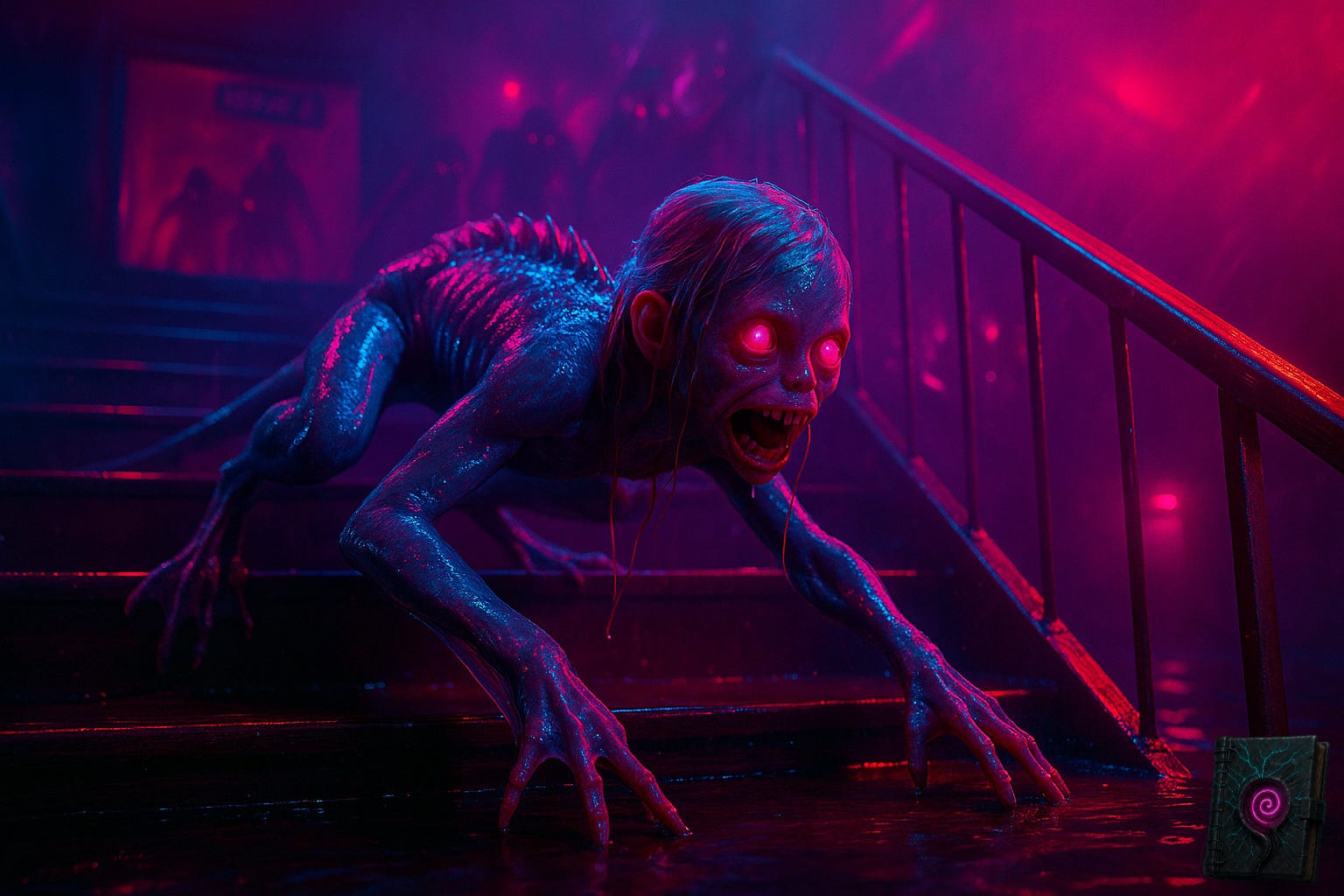
Emma stood. Four feet tall. Gangling like a praying mantis. Skin gray-blue and slick, covered in a thin layer of mucus that smelled like salt and decay. Gills flexing desperately along her neck and between her ribs, clicking with each failed breath. The sound was like bones rattling in a box.
She looked at her mother through the glass.
For just a moment, Emma’s huge eyes focused. Recognition flickered there. Human awareness trapped in an alien body. Her mouth opened, trying to form words. “Mom” came out as a wet clicking sound, barely recognizable. Wet bones grinding.
Then the humanity faded. The clicking intensified. Emma turned toward the door, toward the water she could sense beyond. The compulsion overrode everything else.
Her mother collapsed against the glass, sobbing.
Maya stood frozen, watching. She’d seen death before. Hundreds of times. But she’d never watched someone stop being human while they were still alive.
The other five infected in the room were transforming too, all synchronized, all reaching the same developmental stage together. Like their bodies were following the same internal clock, the same genetic program. David’s transformation was the most violent. His limbs elongated so fast Maya heard his joints pop and crack, ligaments tearing, reforming, strengthening.
Collective metamorphosis.
The clicking from all six reached crescendo. Then the door to conference room A exploded outward. Not from force. From corrosion. The lock had been exposed to the same secretions the transformed emitted, the same mucus coating their skin. Enzymes designed to dissolve metal. The lock had failed in seconds.
The six transformed poured into the hallway, heading for the flooded ground floor. Heading for water. Heading home.
Emma’s father grabbed his wife, pulled her back from the empty conference room. They held each other, watching their daughter disappear down the stairs, moving with inhuman speed and grace. Her body adapted for swimming, not walking, but she moved like water flowing downhill. Inevitable.
Maya turned away. She couldn’t watch anymore. Couldn’t process what she’d just witnessed.
But she knew she’d never forget it. Never forget the sounds. The smell of frost and brine and chemical sweetness. The sight of a child’s spine cracking itself longer while her mother watched through glass.
That was the true horror. Not death. Transformation. Watching someone you love become something that remembers your face but doesn’t care anymore.
DAY ONE: 11:15 PM
The main dining room had become a war zone.
Maya reached the second-floor balcony and looked down at chaos. The transformed had broken through windows on the east and west sides simultaneously, coordinated assault. They moved through the knee-deep flood water with terrifying grace, faster than humans had any right to move.
She counted fifteen of them now. Nine from the lagoon. Six from conference room A, including Emma and David. All naked, skin gray-blue and slick like dolphin hide. Taller than they’d been as humans, limbs elongated for swimming. Gills flexing along their necks and between their ribs, filtering oxygen from the water around them. Eyes larger, reflective, adapted for deep-water vision.
Their faces were still recognizably human but wrong. Mouths slightly too wide. Noses reduced to small slits. Ears flattened against their skulls. Like evolution had taken a human face and optimized it for a different environment.
One of them was Trevor. She recognized his build, his blond hair now plastered to his skull. He stood in the water looking up at the balcony, at the panicked guests. His skin was ice-cold. Maya could see frost forming where he touched the warmer air, melting and reforming with each breath. Steam rose from his body in clouds.
His mouth opened. Instead of words, a sound came out. Low frequency, felt more than heard, vibrating through the water and the walls. The other transformed echoed it. The sound layered, harmonized, became something that made Maya’s teeth ache and her vision blur. She tasted copper. Her nose started bleeding. She felt pressure in her ears, her sinuses, like diving too deep too fast.
Subsonic communication. They were talking to each other through the water.
Emma stood among them, transformed and alien, searching the balcony for her parents’ faces. When she found them, she tilted her head. Curious. The way a cat looks at something it used to play with but now might eat.
Then she made the subsonic sound. The other transformed answered. Their clicking synchronized into a single rhythm, like one massive heart beating. The sound was beautiful and terrible. Maya felt it in her chest, in her bones, in the roots of her teeth.
Then they moved.
Not attacking. Herding. They spread out in coordinated formation, cutting off ground-floor exits, driving the humans toward the stairs. Forcing them into a smaller and smaller space.
“Second floor!” Javier shouted. “Everyone up! Now!”
The guests stampeded. Maya was pushed along in the crush, feet barely touching stairs. Behind her, the transformed followed. Not rushing. Just steady pressure. Patient hunters.
They reached the second floor. Javier and his security team, two men with batons and pepper spray, formed a line at the stairwell. It would buy maybe thirty seconds.
Maya counted heads. Forty-four people. All accounted for. But for how long?
The transformed stopped at the base of the stairs. They stood in the flood water, perfectly still, watching. Waiting. The clicking sound filled the air, rhythmic and coordinated. Steam rose where their cold bodies met the warmer air, creating a fog bank at floor level. The fog smelled sweet. That same chemical attractant. Maya’s mouth watered. She wanted to go closer.
Then Trevor made a different sound. Sharper. More urgent. It echoed through the water.
They were calling for something.
Maya felt vibration through the floor. Subtle at first, then stronger. Something large was moving through the deep water. Something heading toward the resort from the open ocean.
“What the hell is that?” someone whispered.
Maya had no answer. But she had a terrible suspicion that the transformed weren’t the endgame. They were vectors. Carriers. Preparing the way for something else.
The vibration stopped. The transformed made their subsonic sound again, triumphant this time.
Then the breeding chamber broke the surface of the flooded courtyard.
DAY ONE: 11:47 PM
It wasn’t a nest. It was a structure. Deliberately built. Intentionally designed.
The transformed had been working underwater while the storm raged. Using coral, using debris from damaged villas, using their own bodies as construction material. They’d built something that looked like a cross between a wasp nest and a geode, six feet tall, hollow inside, with thousands of small chambers visible through translucent walls.
But the walls weren’t coral or debris.
They were skin. Human skin. Transformed skin. Gray-blue and slick, stretched over a framework of bone and cartilage harvested from earlier victims. The structure breathed, expanding and contracting like a lung, pumping seawater through its chambers with wet sucking sounds.
Each chamber held an egg.
The eggs were roughly human-head-sized, ovoid, translucent. Inside each one, something was moving. Something segmented and wrong. Not human. Not quite worm. Something in between. They pulsed in synchronized rhythm, all together, like a single organism with a thousand hearts. The pulsing made a wet thrumming sound that Maya felt in her chest.
And they glowed. Bioluminescent. But the wrong colors. Deep violet that hurt to look at. Infrared shimmer at the edges that made her eyes water. Colors that shouldn’t exist, colors that made her head throb and her stomach turn.
The geometry was wrong too. The chambers were arranged in patterns that twisted back on themselves, non-Euclidean spirals that made no sense in three-dimensional space. Looking at it too long made Maya nauseous, made her depth perception fail. The structure seemed to be in multiple places at once, overlapping with itself.
And it smelled sweet. Cloyingly sweet. Like rotting flowers mixed with honey mixed with the sea mixed with that same chemical compound from Trevor’s foam. The smell made her mouth water against her will. Made her want to go closer. Made her think about the water, about how good it would feel to submerge, to breathe liquid, to stop fighting. To become.
She shook her head, clearing the compulsion. The breeding chamber was emitting some kind of chemical attractant. Pheromones designed to lure hosts. To make transformation desirable.
“Oh Christ,” Javier breathed. “They’re not just transforming people. They’re breeding.”
Maya understood with horrible clarity. The parasites didn’t just want to spread. They wanted to reproduce. The human hosts were temporary, vessels to build nurseries and lay eggs. Once the eggs hatched, there would be thousands of larvae. Tens of thousands. All seeking new hosts.
The resort wasn’t under siege. It was being converted into a breeding ground.
One of the eggs cracked. A sound like breaking glass. Something pushed through from inside, unfolding, revealing too many legs and a body that looked like a centipede mated with a leech. It was maybe a foot long, translucent, with hooks all along its underside. Its segments pulsed with that same wrong-colored bioluminescence.
It dropped into the water. Swam toward the lodge with terrifying speed, undulating like a ribbon in current.
“Close the windows!” Maya shouted. “Seal everything! Don’t let them”
The juvenile parasite hit the building’s exterior wall and latched on. Its hooks bit into concrete with grinding sounds, like nails on a chalkboard but wetter. It started climbing.
More eggs were cracking. The hatchlings were emerging, dozens of them, all heading for the lodge. For warm bodies. For new hosts. Their clicking filled the air, overlapping with the adult transformed, creating a symphony of wet bone sounds.
The transformed stood watching, still coordinating their subsonic hum. They were protecting the breeding chamber. Guarding the next generation. Steam rose from their cold bodies, creating a fog bank that smelled like brine and rot and that sickly sweet attractant.
“We need to go,” Javier said. “Now. Staff quarters are on the north side, elevated above flood level. If we can reach them”
“That’s two hundred meters across open ground,” Maya said. “In a typhoon. With those things hunting us.”
“You have a better plan?”
She didn’t.
Glass shattered on the second floor. The first juvenile had found a window. It dropped into the hallway, body undulating, hooks scraping tile with wet grinding sounds. A guest screamed. The thing moved toward the sound with horrible speed.
Javier grabbed a fire extinguisher, blasted it with foam. The parasite recoiled, clicking in distress, its body convulsing. It couldn’t tolerate the chemical. But there were dozens more climbing the walls outside, their hooks clicking against concrete in rhythm.
“Conference room B,” Javier said. “Everyone inside. We barricade and wait for first light. Storm should ease by dawn. We move then.”
“And if more of those things get inside?”
“Then we fight them room by room.”
Brutal but simple. Maya nodded.
They got everyone into the conference room. Pushed furniture against the door. The windows were too large to fully block but they covered them with desks, chairs, anything heavy.
Maya counted heads again. Forty-four. Still alive. Still human.
But the clicking outside was constant now. The transformed weren’t leaving. They were settling in. Waiting for their prey to make a mistake.
And Maya knew, with sickening certainty, that some of the humans trapped in this room were already infected. The juvenile parasites were small enough to enter through any opening. Mouth, nose, ears, eyes. Invisible invaders.
The transformation would start soon.
And they wouldn’t know who was infected until it was too late.
DAY TWO: 3:30 AM
The first juvenile emerged from a man’s throat while he slept.
His name was Richard, Australian, early fifties, here with his wife for their anniversary. He’d been fine three hours ago. Normal. Human.
Now something pushed its way out of his mouth, forcing his jaws wider than they should go. A juvenile parasite, foot-long, translucent body glistening with mucus and blood. It had been growing inside him, feeding on his tissue, restructuring his organs from within.
Richard convulsed once. The parasite pulled itself free with a wet sound, hooks scraping tooth enamel. Maya heard the grinding. Heard his jaw crack. Saw teeth break and fall from his mouth like bloody pearls, clicking as they hit the floor.
It dropped onto the floor, oriented toward the nearest warm body, and charged.
Chaos.
People screaming, scrambling away. The parasite was fast, faster than anything that size should be. It latched onto a woman’s leg, hooks biting through fabric and skin, tearing muscle. She fell, shrieking.
Javier grabbed a chair, smashed it down on the parasite. The thing’s body ruptured, spilling black ichor that smoked when it hit the floor, bubbling and hissing. It clicked once, a sound of rage, and went still.
Richard lay on the floor, mouth torn at the corners, blood pooling. His chest heaved once, twice, then stopped. Dead. The parasite had consumed too much of his internal structure. He’d been a mobile incubator, nothing more. When Maya checked him later, she’d find his lungs were gone. Just empty space where they should have been, tissue consumed and converted into parasite mass.
Maya grabbed her medical bag, went to the woman with the leg wound. The hooks had penetrated deep, tearing muscle down to bone. But worse, she could already see the gray-blue tint spreading from the punctures. The parasite’s hooks had been barbed, infected, designed to transmit larvae on contact.
“I’m infected, aren’t I?” the woman said quietly. Her name was Patricia. Australian. Teacher. Mid-forties. Calm in crisis.
“Yes.”
“How long?”
“Six to eight hours until you start showing major symptoms. Maybe less.”
Patricia closed her eyes. “Then you should lock me in a room. Before I become one of them.”
“We don’t have containment that will hold a fully transformed host.”
“Then you need to kill me before the change completes.”
Maya met her eyes. Saw acceptance there. Rational calculation. The same math Maya had been doing since this started. Individual death versus group survival.
“I’ll make you comfortable,” Maya said. “I promise.”
Patricia nodded. Javier helped her to a smaller office, locked the door from outside. Through the window, Maya watched her sit on a chair, hands folded, waiting. Knowing what was coming. Accepting it. Brave.
Maya returned to the main group. Thirty-nine left now. Richard dead, four others infected during the panic. All isolated in separate rooms. All waiting for the change.
Four more hosts for the breeding chamber.
The math was getting worse.
DAY TWO: 5:00 AM
Maya couldn’t sleep. She stood outside Patricia’s office, looking through the glass partition. Checking on the woman who’d chosen to face her transformation alone.
What she saw made her hand freeze on the door handle.
Patricia had filled the small sink with water. She was kneeling beside it, face submerged, breathing. Her hands gripped the porcelain edges, knuckles white. Between her fingers, webbing had formed. Delicate membranes, translucent and veined, glowing faintly with bioluminescence in the dark.
Maya opened the door quietly. Patricia didn’t react to the sound. She was focused entirely on the water, on the act of breathing it, on the alien satisfaction of oxygenating through gills instead of lungs.
Maya stepped closer. Saw Patricia’s neck. The gills were fully formed now, flexing with wet clicking sounds. The skin around them was gray-blue, cold enough that frost formed in the warm office air, ice crystals blooming and melting in cycles.
“Patricia?”
The woman’s head lifted. Water streamed from her face, running down her neck, over those new gills that opened and closed like second mouths. Her eyes had changed, pupils expanding to take up most of the iris, reflecting light with greenish glow. They focused on Maya with difficulty, like looking through water at something on land.
“It doesn’t hurt,” Patricia said. Her voice had that subsonic resonance now, making Maya’s teeth ache and her chest vibrate. “I thought it would hurt. But it feels... right. Like I’ve been drowning my whole life and I’m finally learning to breathe.”
“You’re still aware,” Maya said. “You’re still yourself.”
“For now.” Patricia looked at her webbed hands. Flexed them. The membranes stretched, nerve-dense and sensitive. She winced, then smiled at the sensation. “But I can feel it. The other thoughts. The clicking. It’s getting louder. Calling me to the water. To the others. Soon I won’t be able to fight it. Soon I won’t want to.”
“How much longer?”
“Minutes. Maybe less.” Patricia stood. She was taller now, joints reconfigured, limbs elongated. Her skin was cold, so cold that moisture from the air condensed on her arms and face, running down in streams. “When I go, when I’m not me anymore, don’t let me hurt anyone. Promise me.”
“I promise.”
Patricia smiled. It was wrong on her transformed face, too many teeth, mouth too wide. But human emotion showed through. Gratitude. Acceptance. Peace.
“Thank you. For trying. For being kind. For making it matter.”
Then her eyes went distant. The clicking in her throat intensified, became a constant thrumming. She turned toward the window, toward the water beyond, with sudden terrible focus.
The compulsion had won.
Patricia moved to the door, tried the handle. Locked. She pulled once, testing. The handle bent under her grip like soft plastic, metal warping and groaning. Transformed strength.
Maya backed out of the room quickly. Locked it from outside. Watched through the glass as Patricia stopped trying the door and simply waited, swaying slightly, clicking in rhythm with the transformed outside.
Calling and being called.
Responding to something Maya couldn’t hear.
The subsonic frequency from the water. From the breeding chamber. From the other transformed.
Calling her home.
Patricia pressed her cold hands against the window glass. Left frost prints. Then she turned away, walked to the sink, submerged her face again. Breathing. Waiting. Patient.
Soon, Maya knew. Soon Patricia would be strong enough to break through the door. To join the others in the water. To stop being human entirely.
And there was nothing Maya could do to stop it.
DAY TWO: 6:15 AM
Dawn came gray and exhausted.
The storm had eased to heavy rain. Wind down to maybe fifty kilometers per hour. Survivable. The kind of weather where helicopters could fly if they hurried.
Maya stood at the window, satellite phone to her ear. She’d been calling for two hours. Finally, someone answered.
“Philippine Coast Guard, how can we help you?”
“This is Coral Bay Resort. We have a medical emergency. Parasitic outbreak. Multiple casualties. We need immediate evacuation and quarantine protocols.”
Silence. Then: “Can you describe the outbreak?”
“Waterborne parasitic organisms. Flatworm genus, unknown species. Transmission through skin contact with contaminated water. Causes rapid physiological transformation. Hosts develop aquatic adaptations. Gills, webbing, restructured respiratory and circulatory systems. Transformation completes in six to eight hours.”
More silence. “Ma’am, are you saying people are turning into... fish?”
“I’ve watched twenty-three people undergo complete metamorphosis from human to aquatic-adapted organisms. I’ve seen them build breeding structures. I’ve seen secondary-stage juveniles emerge from incubated hosts. This is a real outbreak and it’s spreading.”
“We’re dispatching a helicopter. ETA ninety minutes. Prepare for immediate evacuation. Any individual showing symptoms cannot board. Quarantine protocols require”
“I understand. I’ll screen everyone.”
She hung up. Turned to face the remaining survivors. Thirty-nine people. Exhausted. Terrified. Some crying. Some too numb for tears.
“Helicopter’s coming,” she said. “Ninety minutes. Anyone who’s clean gets on. Anyone showing symptoms stays behind.”
Murmurs. Fear. But understanding. They’d all seen what happened to the infected. No one wanted to be the vector that spread this to Manila.
Maya started screening. Temperature checks. Skin examinations. Looking for that telltale gray-blue discoloration. The beginning of webbing. Any sign the parasites had entered.
Thirty-five tested clean.
Four didn’t.
One was Emma’s father. The man from Sydney who’d watched his daughter transform through glass. Somewhere in the chaos of the last six hours, he’d been infected. Maybe a juvenile parasite. Maybe contaminated water. The gray-blue tint was spreading from a scratch on his forearm, branching up toward his elbow like frost on glass.
He looked at Maya with dead eyes. “How long?”
“Hours. Maybe less.”
“My wife?”
“Clean.”
He nodded. Turned to his wife, who was crying silently. “Take care of yourself. Don’t look back. Don’t think about us. Just survive.”
“I’m not leaving you.”
“Yes, you are. Because that’s what I need. I need to know you got out. That our daughter’s death and mine meant something. Please.”
They embraced. Maya looked away, giving them privacy. But she heard them. The quiet words. The promises. The goodbye that would be their last.
When they separated, Emma’s mother was holding a small photograph. Emma as a toddler, laughing, covered in ice cream. Back when the world made sense.
The father went to join the other three infected in a conference room. They sat together, not speaking, waiting for the transformation that was now inevitable.
Maya checked her watch. Seventy minutes until extraction.
They just had to hold on a little longer.
DAY TWO: 7:30 AM
The escape plan was simple.
Move in two groups. First group: twenty strongest, fastest. They’d make the run to the helipad, two hundred meters north, secure the area. Second group: remaining fifteen. They’d follow once the path was clear.
Maya would go with the second group. Her medical skills were needed for the most vulnerable.
Javier would lead the first group. His military training made him the obvious choice.
But when Maya tried to follow the plan, Javier stopped her.
“I’m not coming back,” he said quietly.
“What?”
“The transformed are out there. Waiting. The first group might make it because they’re expecting us to run. But they’ll pursue. Cut us off. The second group will be walking into an ambush unless someone creates a distraction.”
“Javier, no. We can”
“The math doesn’t work any other way, Maya. You know it. I know it. Someone has to stay behind. Lead the transformed away from the helipad. Give everyone else time to evacuate.”
Maya wanted to argue. Wanted to find another solution. But fifteen years in field clinics had taught her brutal arithmetic. Sometimes you saved who you could and mourned the rest.
“I’ll make it count,” Javier said. “Give me twenty minutes. That’s all I need.”
He gripped her shoulder. Then he was gone, moving down to the flooded ground floor, fire axe in hand.
The first group descended three minutes later. They moved fast, staying together, wading through hip-deep water toward the north exit. Maya watched from the second floor, counting heads, tracking their progress.
They were twenty meters from the exit when the transformed struck.
They came from beneath the water, coordinated ambush. Six of them, including Trevor and David and Emma, cutting off the group’s escape. The humans scattered, some making it to the exit, others trapped.
Then Javier appeared on the south side of the dining room. He was carrying something. A propane tank from the kitchen, valve open, gas hissing.
“Hey!” he shouted at the transformed. “Looking for me?”
He threw the tank into the breeding chamber.
The transformed shrieked, that subsonic scream Maya had heard before, amplified by rage. The breeding chamber was their priority. Their purpose. They abandoned the humans, dove toward the chamber, trying to protect it.
Javier pulled a road flare from his belt. Lit it. The magnesium burned white-hot, smoking.
“Run!” he screamed at the first group. “Now!”
They ran. The transformed were focused on Javier, on the threat to their nursery. The first group made it through the exit, disappeared into the rain.
Javier looked up at Maya on the balcony. Smiled. Saluted.
Then he threw the flare.
The propane ignited with a sound like thunder. The breeding chamber exploded, sending burning debris and boiling water in all directions. The skin-walls ruptured, spilling eggs into the fire. They burst with wet popping sounds, juveniles inside cooking alive, clicking in agony that sounded almost like screaming.
The transformed caught in the blast convulsed, their bodies not designed to withstand that kind of thermal shock. Their cold flesh blistered and burned. The frost on their skin melted, boiled, steamed.
But the transformed kept coming. They swarmed Javier, pulling him under, holding him down. Not to convert. To kill. Revenge for destroying their nursery.
Maya watched Javier fight. Watched him swing the axe, taking one transformed’s arm off at the elbow. Black blood sprayed. The transformed didn’t slow. Watched him bite another’s throat, human teeth tearing transformed flesh that was cold as ice. Watched him refuse to die quietly.
He got three of them. Killed them or damaged them enough that they stopped moving. But there were too many.
They dragged him deeper into the flooded room. Trevor grabbed his head, pushed it under. Held it there with transformed strength. Javier thrashed, fought, tried to surface. His hand broke the water once, reaching up, grasping at nothing.
Then it went still.
The water turned red. Then black as transformed blood mixed with human.
“Second group!” Maya shouted, voice breaking. “Move now!”
They descended. Moved fast toward the north exit. The transformed were distracted, grieving their destroyed breeding chamber, fighting over Javier’s body.
Fifteen people ran through the rain toward the helipad. Maya counted heads. All accounted for. Including Emma’s mother, who clutched that photograph like a lifeline, protecting it from the rain with her body.
They reached the helipad. The first group was already there, huddled under the small shelter. Thirty-five survivors total.
The helicopter appeared through the clouds. Military transport. Olive drab. Armed soldiers.
It landed. The soldiers jumped out, weapons ready. They loaded the survivors quickly, efficiently. No questions. Just extraction.
Maya was the last to board. She looked back at the resort one final time.
The main lodge was dark, flooded, damaged. The breeding chamber was destroyed but she could see the transformed already rebuilding, using the rubble, tireless and patient. They were dragging something through the water. Javier’s body. Taking him to the depths. She didn’t want to think about what they’d do with him there.
Four infected humans were still in that building. Emma’s father and three others. Waiting to complete their transformation. To join the others in the water.
And in the lagoon, more shapes moved. Dozens. Maybe hundreds. The original population that had been there before Trevor, before anyone from the resort. The source of the parasites.
They were still there. Still breeding. Still waiting for the next group of humans to swim in their contaminated water.
Maya climbed into the helicopter. The door closed. They lifted off.
Below, the transformed watched them go. Unblinking. Patient. Steam rising from their cold bodies in the warm rain.
The world had a lot of water. A lot of beaches. A lot of lagoons where people swam without knowing what lived beneath the surface.
The wet was coming.
And humanity had no idea how to stop it.
EPILOGUE: THREE MONTHS LATER
Maya stood in the CDC laboratory in Atlanta, looking at the tank.
Inside, floating in carefully controlled seawater, was a transformed human. Female, mid-thirties, recovered from a beach in Thailand three weeks after the Coral Bay incident. She’d been a tourist. Swedish. Went swimming. Got infected. Transformed.
Now she floated in the tank, gills flexing, webbed hands pressed against the glass. Her eyes were huge, reflective, no longer quite human. But when Maya looked at her, the transformed woman tilted her head. Curious. Maybe even aware.
“She’s been trying to communicate,” Dr. Patel said. The CDC’s lead parasitologist. “Subsonic vocalizations. We think she’s calling for others like her.”
“Have you found others?”
“Seventeen confirmed cases worldwide. Philippines, Thailand, Indonesia, Australia, Mexico. All coastal areas. All from contaminated swimming sites. The parasite is spreading.”
“Can it be stopped?”
Patel shook his head. “The organism exists in hundreds of coastal ecosystems. Maybe thousands. It might have been there for millions of years, just dormant. Or maybe it’s new, evolved from some other parasite. We don’t know.”
“And the transformed?”
“We’ve tried antiparasitics. Tried surgical removal. Tried everything. The integration is too complete. The host and parasite are one organism now. You can’t separate them without killing both.”
Maya looked at the transformed woman. Watched her float in the tank with impossible grace. She looked peaceful. Happy. Like she’d found something she’d been searching for her entire life.
Maya pulled out the photograph. Emma as a toddler, laughing, covered in ice cream. Emma’s mother had pressed it into Maya’s hands before boarding the helicopter, unable to look at it anymore. “Keep her,” she’d said. “Remember her before.”
Maya held it up to the glass.
The transformed woman stopped moving. Focused on the photograph. Her huge eyes tracked across the image, recognition flickering in depths that were no longer quite human.
Then she pressed both webbed hands against the glass, right where the photograph was. Her gills flexed rapidly, clicking. Not distressed. Something else. Something like longing.
Memory.
“They remember,” Maya whispered. “After everything, they still remember.”
“What happens to them?” Maya asked.
“We keep studying them. Try to understand the transformation process. Maybe find a way to prevent infection before it reaches critical stage.”
“And if you can’t?”
“Then we quarantine coastlines. Ban swimming in contaminated waters. Hope it doesn’t spread inland through rivers and lakes.”
Maya thought about all the beaches in the world. All the people who swam without thinking about what might be in the water. All the children playing in the surf, splashing, laughing, getting tiny cuts on rocks and coral.
All potential hosts.
“It’s already too late, isn’t it?” she said quietly.
Patel didn’t answer. He didn’t need to.
The transformed woman in the tank made that subsonic sound. Low frequency, felt more than heard. Maya’s teeth ached. Her vision blurred. The photograph trembled in her hand.
In other tanks throughout the lab, other transformed specimens answered. The sound layered, harmonized, became something beautiful and terrible.
They were calling.
And somewhere in the world’s oceans, something was listening.
END
