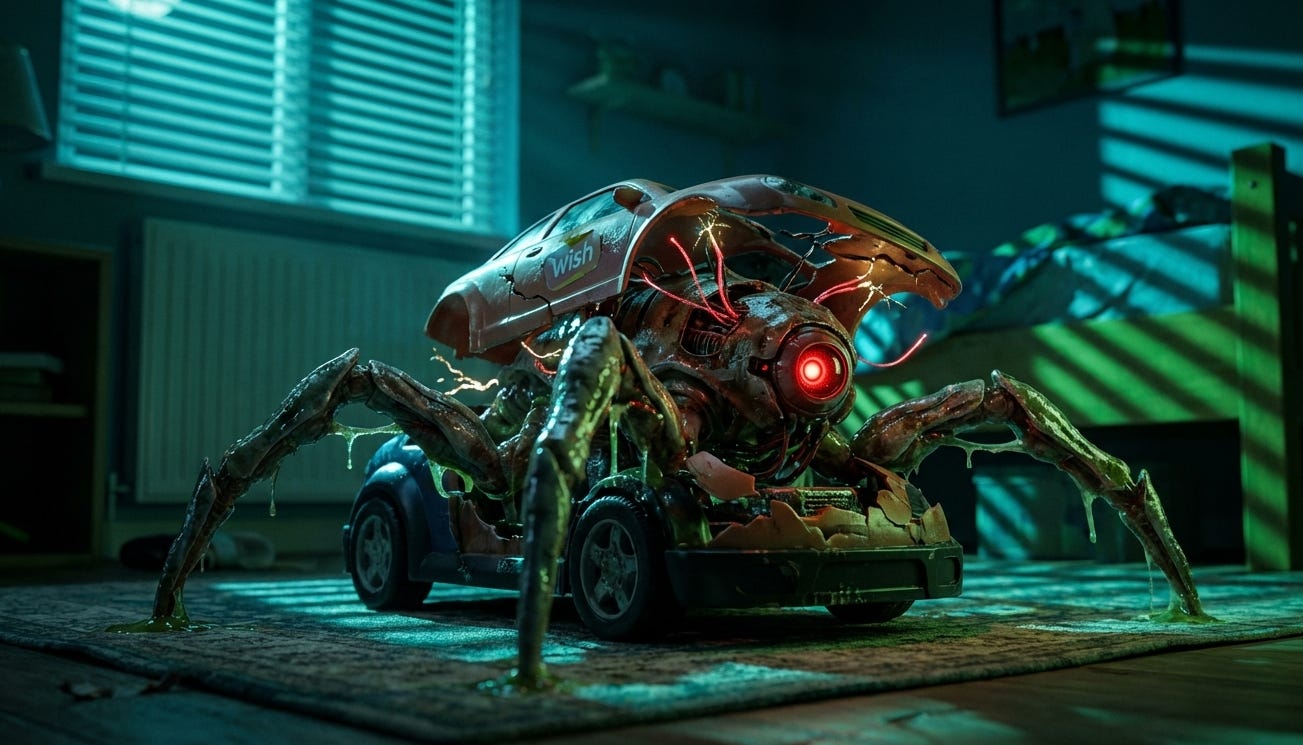
Wish.com’s Fifty-Fifty Chance Your Kid Gets Electrocuted
Wish.com is a digital slot machine where instead of winning money, you win the chance your product might only be fake instead of lethally dangerous. Ninety-four percent of Wish merchants are based in China. The platform takes a 15 percent cut of every sale, which CEO Peter Szulczewski justified by claiming Wish does a lot more for merchants than Alibaba. What they do, according to multiple lawsuits and investigations by consumer protection agencies across three continents, is knowingly sell counterfeit, fake, and knock-off products that violate intellectual property rights, safety standards, and occasionally the Geneva Convention.
Which? purchased 23 toys from online marketplaces including Wish and found that 52 percent posed serious safety risks to children. Fifty-two percent. More than half. Choking hazards where small parts detach with minimal force. Sharp points that violate basic toy safety standards. Strangulation risks from cords and strings that exceed maximum length regulations. Wish sold car seats that failed crash testing so catastrophically that test dummies suffered injuries equivalent to fatal head trauma. Fake Apple headphones that could electrocute you because the voltage regulation is nonexistent and the wiring is whatever copper scraps were cheapest that day. Smartphone chargers that spontaneously combust because nobody installed proper circuit breakers or thermal fuses. You ordered a twenty-dollar Bluetooth speaker and received a potential house fire in a box with your address on it.
The platform’s return policy is a labyrinth designed to exhaust you into giving up. Items ship from Shenzhen warehouses with 45-day delivery windows, and by the time you realize the Bluetooth speaker is a hollow plastic shell with a picture of a circuit board printed inside, the return window has conveniently expired. The customer service is chatbots programmed to apologize and offer five-dollar credits. You wanted your money back. They offer you five dollars in Wish Cash to spend on more counterfeit garbage. The refund process requires photographs, written complaints, multiple follow-ups, and eventually you just give up because your time is worth more than the fifteen dollars you spent on a fake phone charger that tried to murder your phone.
You are not shopping. You are playing Russian roulette with your credit card, where five chambers hold garbage and one chamber holds something that might actually burn your house down. The gun is always loaded. You just do not know which chamber has the bullet until you pull the trigger by plugging in the charger you bought for three dollars.
Wish does not verify products. They verify payment processing. Your money is authentic. Everything else is negotiable. The platform operates as a marketplace, which legally shields them from liability for what their merchants sell. Wish is just the infrastructure, they claim. They are not responsible for the fake Nike shoes or the counterfeit car seats or the exploding phone chargers. That is the merchants. Wish just collects fifteen percent of every transaction and looks the other way while their merchants sell products that violate every consumer safety regulation written in the past century.
There are approximately forty million monthly active users on Wish. Forty million people shopping a platform where more than half the products are either fake, dangerous, or both. You wanted a deal. You got a counterfeit lottery where the prizes are disappointment and the grand prize is a product that violates safety standards so egregiously it could fucking kill you. Three-dollar USB cables that short circuit and melt. Five-dollar toys with lead paint and detachable choking hazards. Ten-dollar electronics with no electrical certification and fire risks so severe that consumer protection agencies have issued specific warnings about Wish purchases.
Your money is authentic. The products are Russian roulette. And Wish is making millions collecting fifteen percent of every transaction while you gamble with your safety.