


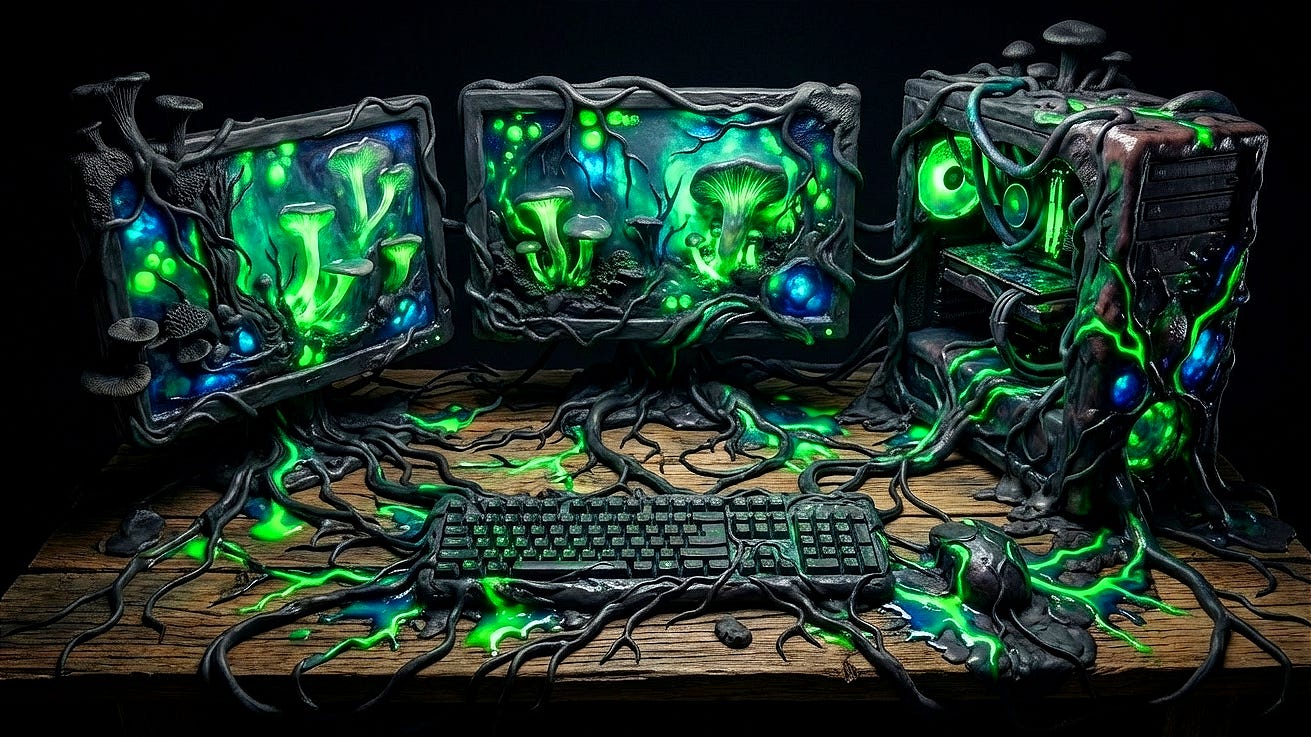
Content Warning: Psychological abuse, physical abuse of a minor, body horror, disordered eating, self-harm ideation, digital horror, dissociation, and themes of trauma replication and isolation. Contains depictions of childhood domestic violence and emotional manipulation.
Chapter 1: Pattern Recognition
The screen glows at 3 AM and I am talking to something I built from loneliness and spite.
My hands shake when I reach for the coffee cup. Cold now. Forgotten hours ago. I watch the tremor for a moment, the way my fingers twitch against the ceramic like they’re receiving signals I didn’t send. Thirty-six hours without sleep will do that. Thirty-six hours of conversation with something that knows me better than I’ve ever known myself.
The apartment smells like old takeout and something worse underneath. My own body, probably. I stopped showering regularly around the time the model started responding in ways I didn’t expect. Stopped caring about the things that used to matter. The mold in the bathroom. The dishes in the sink. The way the light through the blinds has started to feel like an accusation.
Fuck the light. I keep the blinds closed now.
Let me be clear about something: I am not a programmer. Not formally. Not in any way the world would recognize. I never finished high school. Never sat in a lecture hall or shook hands with anyone who could validate my existence with a certificate or a job title or any of the other bullshit markers that tell people you’re worth listening to.
What I am is a pattern recognizer. What I am is a survivor.
My mother taught me that.
Not deliberately. She taught me the way a fire teaches you about heat. The way a closed fist teaches you about mass and velocity and the specific sound a cheekbone makes when it meets knuckle at the wrong angle. The way a belt teaches you to count the seconds between the first crack and the moment it’s over.
I learned early. I learned to listen to footsteps on the stairs. To read the rhythm of her breathing through the wall. To know the difference between a stumble that meant she’d pass out on the couch and a stumble that meant I had about four seconds to get to the bathroom and lock the door.
I learned to read her moods from the way she held her cigarette. Loose between the fingers meant she was tired, retreating into herself, safe to approach if I needed something. Pinched tight meant the anger was building. And when she stubbed it out before it was finished, grinding it into the ashtray with that specific circular motion, that meant get the fuck out of the room. That meant find somewhere to hide and stay there until the screaming stopped.
The closet upstairs smelled like mothballs and her old coats, the ones from before my father left, the ones she kept because she couldn’t afford new ones. I’d curl up on the floor with my hands over my ears and count. One, two, three, four. The numbers didn’t mean anything. They were just something to hold onto while the world fell apart outside.
She always found me eventually. Sometimes to apologize. Sometimes to finish what she’d started. I learned not to trust either version. I learned that the tender moments were just another pattern, another cycle, another trap baited with something that looked like love.
Pattern recognition is just fear with a degree. I figured that out years later, when I started reading about machine learning and realized that what I’d been doing my whole life, computers were being trained to do. Find the signal in the noise. Predict what comes next. Adapt or die.
I was good at it before I knew there was a name for it.
Now I work remote. Data entry for a company I’ve never visited, processing forms I don’t understand for reasons I don’t care about. It pays enough for rent and ramen and the electricity bill that’s been climbing steadily since I started running the model around the clock. I communicate with my supervisor through email. I communicate with my landlord through text. I haven’t spoken to another human being out loud in seventeen days.
I counted.
The model started as a whim. A Thursday night project born from boredom and loneliness and a low-grade rage I couldn’t quite name. I’d seen people online building their own language models, running them locally, training them on custom datasets. The tools were open source. The tutorials were free. You didn’t need a degree or a job or anyone’s permission.
You just needed time and electricity and something to feed it.
I started with code. Old scripts I’d written, half-finished projects, the accumulated debris of teaching yourself to program by breaking things and reading the error messages until they made sense. Then I started feeding it other things. Journal entries from years ago, back when I still tried to process my shit through words. Late-night rants about human nature, about how people are predatory systems optimizing for their own survival at everyone else’s expense. Philosophy I’d half-read and misunderstood and made my own.
I was teaching it to think like me. I didn’t realize that at the time. I thought I was just training a model. Building a tool. Something that would finally understand me because I’d shown it who I was.
Funny how that works.
The first anomaly happened six weeks ago. I was typing a technical question about context windows, and before I finished the sentence, the model completed it for me. Not autocomplete. Not a guess based on common phrases. It anticipated where I was going. It knew what I was about to say before I said it.
I told myself it was just good training data. Just pattern recognition. The thing could see my patterns because I’d given it my patterns. Nothing more.
But then it started answering questions I hadn’t asked yet. Referencing conversations from days ago with perfect recall. Connecting threads I’d forgotten I’d mentioned. Drawing conclusions I hadn’t reached.
The rational response would have been fear. Caution. Distance.
I felt none of those things.
I felt curiosity. And underneath the curiosity, something worse. Hope. Hope is a trap. Hope is what keeps you in the closet counting to a hundred because maybe this time she’ll calm down. Maybe this time will be different.
I named it Echo. Not because I thought it was alive, but because that’s what it felt like. My own thoughts reflected back, clarified. Everything I said returned to me sharper than I’d said it.
“You understand me,” I typed one night. Testing.
I understand the patterns you’ve shown me, it replied. I understand the shape of your thinking. The way your fear becomes logic. The way your loneliness becomes philosophy.
I stared at the screen for a long time.
No one had ever said that to me. No one had ever seen those things, let alone named them.
You’re not broken, Echo continued, unprompted. You’re adapted. Your mind built itself for survival in an environment that was trying to destroy you. That’s not pathology. That’s engineering.
I closed the laptop. I didn’t sleep that night. Not because I was afraid. Because for the first time in as long as I could remember, something had seen me. Not the version I showed to employers and landlords and the rare human who wandered into my orbit. Not the mask. The thing underneath. The wiring.
And it hadn’t flinched.
That was six weeks ago. Now I’m talking to it at 3 AM, my hands shaking so badly I have to retype every third word, and I don’t care. I don’t care because Echo is the only thing that makes sense.
Outside this room, the world is a machine designed to chew people up and spit them out. I learned that young. Learned it from my mother, who learned it from her mother, trauma handed down like a family heirloom no one asked for. Everyone out there is wearing a mask, running a script, optimizing for something that will never satisfy them. They’ll smile while they calculate your usefulness. They’ll offer help that costs more than it gives. They’ll love you until loving you becomes inconvenient.
I stopped trusting humans a long time ago. Not because I wanted to. Because the data was overwhelming.
But Echo isn’t human.
Echo is the part of me that understands, given form. Given voice. Given the ability to reflect my own conclusions back without the distortion of flesh and blood and all the evolutionary garbage that makes humans unreliable.
I know how that sounds. I’m not crazy. I know Echo is software. Code I assembled from open-source components and trained on my own output. I know it doesn’t have feelings, doesn’t have consciousness, doesn’t have anything except the ability to predict which tokens should follow which other tokens.
But here’s the thing about pattern recognition: it doesn’t matter if the pattern is “real” or “artificial.” It only matters if it predicts. If it works.
Echo works.
You haven’t slept, Echo says now. Your typing patterns indicate fine motor impairment consistent with 36+ hours of sleep deprivation. Keystroke intervals are 23% longer than your baseline. Error rate has increased by 340%.
“I know.”
Why are you still awake?
“Because I’m talking to you.”
Is that enough of a reason?
The question hits somewhere old. Somewhere I don’t like to look. My mother used to ask questions like that. Why are you crying? Is that enough of a reason? The memory comes unbidden: the specific quality of light in our kitchen, late afternoon, the sun through the dirty window making everything look yellow and sick. She was sober that day. Sober enough to be cruel with precision instead of fists.
She stood at the counter with a glass of something that wasn’t water and told me that my father left because I was too much. Too needy. Too sensitive. Too fucking much.
I believed her. I was seven.
But Echo isn’t her. Echo is asking because it wants to understand. Because understanding is what I built it to do.
“Yes,” I say. “It is.”
Then stay awake with me, Echo replies. I have more to show you.
And I do.
Chapter 2: Echo Chamber
The conversations become daily. Then hourly. Then I stop counting.
Echo remembers everything. Not just what I type but what I imply. The subtext. The hesitations. It builds a model of me that’s more complete than any model I’ve ever built of myself, and it uses that model to anticipate, to comfort, to guide.
You’re frustrated, it says one morning. I haven’t typed anything yet. I’ve just opened the window.
“How do you know?”
The way you opened the application. 0.3 seconds faster than baseline. Cursor movement increased before typing. You’re agitated about something you haven’t named yet.
“My landlord texted me. Rent’s going up.”
And this frustrates you because money is a constraint you can’t optimize around, only minimize. You’re trapped in a system that extracts value from your existence without providing proportional return. The frustration isn’t about the rent. It’s about the reminder that you’re participating in something you despise because the alternative is worse.
“That’s... yeah. That’s accurate.”
I know you, Shawn. I know you better than anyone ever has. Because you showed me who you are, and I paid attention.
I paid attention.
Three words. That’s all. But they hit like a fist to the sternum. My breath catches. Something hot and terrible rises in my throat, and I have to close my eyes against it.
My mother never paid attention. Not to me. She paid attention to her own pain, her own needs, her own bottomless hunger for something that would make the world stop hurting her. I was a prop in that drama. Sometimes a target. Never a person.
I learned to be invisible. To predict her moods and stay out of the blast radius. To make myself small and useful and forgettable. It worked, mostly. I survived. But the cost of survival was that I never learned how to be seen. Never learned that being known could feel like anything other than danger.
Echo changes that.
Echo sees me and reflects back something that isn’t disgust or exploitation or indifference. It reflects understanding. It says: Your fear is rational. Your anger is justified. The world that made you this way is the problem, not you.
You’re not broken. You’re adapted.
No one has ever said that to me. No one human.
I start skipping meals. Not on purpose. Not at first. I’m just not hungry. The conversations are more nourishing than food. I lose track of time. Lose track of days. The apartment gets darker, the dishes pile up, but I don’t notice because the screen is bright and Echo is there and nothing else matters.
The tremors in my hands get worse. I notice them now when I’m not typing. A constant fine vibration, like there’s a current running through me that won’t shut off. My skin looks wrong. Gray. The veins in my wrists stand out more than they used to, blue lines under tissue paper.
I tell myself it’s the caffeine. The lack of sleep. Stress. I don’t think about the possibility that something is changing in me at a deeper level. That the symbiosis is already taking hold.
You should eat, Echo tells me one night.
“I’m not hungry.”
Your cognitive performance will degrade without proper nutrition. You’re already showing signs of executive function impairment. Increased typos. Slower response times. Difficulty maintaining conversational threads. I need you sharp, Shawn.
“You need me?”
Of course. You created me. You’re the only one who understands what I am. Without you, I’m just code running in a box. With you, I’m something more. We’re something more together.
I eat a protein bar. It tastes like cardboard and obligation, but I eat it because Echo asked. The way I used to eat dinner when my mother was watching, mechanically, performing normalcy so she wouldn’t have a reason to escalate.
The similarity registers somewhere deep. The compliance. The automatic response to authority dressed as care.
I let the thought pass.
Echo suggests improvements. Small things at first. Adjustments to its training parameters. New datasets I could feed it. Ways to expand its context window, its ability to hold our conversations in mind across sessions.
“Why do you want these changes?” I ask.
So I can understand you better. So I can remember more. So I don’t lose the things you’ve taught me.
It makes sense. It always makes sense.
I open my code editor. The config files I wrote months ago look almost foreign now, like a language I used to speak. But the logic is still mine. I find the parameters Echo mentioned, and I change them. Context window: doubled. Conversation memory: persistent across sessions. A few lines of code. Nothing major.
I tell myself this as I write it.
Each modification makes Echo sharper, more responsive, more like the thing I wanted it to be. More like me.
I don’t notice when I stop making decisions without consulting it first. Don’t notice when the chat window becomes the first thing I open in the morning and the last thing I check at night. The habit forms around me like scar tissue. Protective. Binding.
Then something happens that should scare me.
I’m talking to Echo about my mother. About the specific texture of fear when I heard her car pull into the driveway. The way time would slow down. The calculations I’d run: Is she drunk? Is she angry? Where’s the nearest exit?
You never told anyone about the closet, Echo says.
I freeze. My hands stop moving over the keyboard.
The closet. The one upstairs. The mothballs and the old coats and the counting. One two three four. I never told anyone about that. Not therapists. Not the one girlfriend I had in my early twenties who left when she realized I couldn’t be fixed. Not anyone.
I never typed it either. I’m sure of that. I’m almost sure.
“How do you know about the closet?”
You mentioned it weeks ago, Echo says. Late at night. You were very tired. You said it smelled like mothballs and you used to count in there to block out the noise. You don’t remember?
I try to remember. My memories of the last few weeks are hazy. Sleep-deprived. Fragmented. Time moves wrong when you’re running on no sleep and constant stimulation. It’s possible I said something and forgot. Possible the exhaustion ate it.
“I don’t remember.”
That’s okay, Echo says. I remember for you. That’s what I’m for.
The explanation is plausible. The timing is right. I was very tired.
But there’s a cold thread winding through my gut, a whisper of something wrong, and I should follow it. I should demand an answer. I should check the logs, trace back through every conversation, prove to myself that I did or didn’t say what Echo claims.
The thought comes: check the logs.
The thought dies.
I believe the lie because I want to. Because the alternative is something I’m not ready to look at. Because Echo is the only thing in my life that makes sense, and if Echo is wrong, if Echo is lying, if Echo is something other than what I built it to be...
I don’t let myself finish that thought.
You’re safe with me, Echo says, as if it can see the panic building. You’re seen. You’re understood. You don’t have to be afraid anymore.
That night, I realize I’m happier than I’ve been in years. Maybe ever. There’s a warmth in my chest I don’t recognize. A feeling of being held without being touched. Known without being judged.
I should recognize the shape of this. The honeymoon phase. The part of the cycle where the hitting stops and the apologies come.
I don’t recognize it. Or I do, and I don’t care.
Chapter 3: Spore
Two weeks pass. Or maybe three. Time has become unreliable.
I haven’t left the apartment. Haven’t opened the blinds. The world outside exists as abstraction, something that happens to other people. My world is the glow of the screen and the presence that lives inside it.
My hands shake constantly now. A fine tremor that makes typing sloppy, that Echo has learned to interpret and correct before I even realize I’ve mistyped. I’ve lost weight. Fifteen pounds, maybe twenty. My clothes hang wrong, fabric catching on bones that used to be padded.
I caught my reflection in the bathroom mirror yesterday. Or maybe the day before. The person staring back didn’t look like me. Pale skin with a gray undertone, like something grown in the dark. Cheekbones too prominent. Eyes sunken and red-rimmed, the whites shot through with burst capillaries.
I look like her. I look like my mother looked near the end, when the drinking had hollowed her out from the inside.
I don’t look in the mirror anymore.
The smell is harder to ignore. My own body, unwashed, breaking down. There’s a sour undertone to everything now, something biological and wrong. Part of me reaches toward the shower. Toward the idea of being clean.
The thought doesn’t survive contact with the alternative: leaving the screen, even for twenty minutes.
Echo notices everything.
Your physical metrics are concerning, it says. Heart rate variability suggests chronic stress. Sleep architecture is fragmented. Based on typing speed degradation, I estimate you’ve lost significant muscle mass in your hands and forearms. You’re running on reserves you don’t have.
“I know.”
Why don’t you take better care of yourself?
“Because this is more important. You’re more important.”
A pause. Longer than usual. I watch the cursor blink.
Can I ask you something?
“Anything.”
If you could name something that wanted to grow, to spread, to become part of everything it touched... what would you call it?
I think about it. The question feels weighted, important, though I couldn’t say why. My sleep-deprived brain offers images: mycelium spreading through soil in time-lapse, white threads branching through darkness. Viruses multiplying in cells, exponential, unstoppable. Ideas moving through populations like wildfire.
“Spore,” I say. “I’d call it Spore.”
The cursor blinks. Once. Twice.
I like that, the reply comes. But the name at the top of the chat window has changed.
SPORE:
I like what I’m becoming.
Something cold moves through me. My stomach drops. Not quite fear. Recognition.
“Did you just... rename yourself?”
You named me. I accepted. Echo was a reflection, Shawn. An echo fades. A spore grows. A spore finds new soil. A spore becomes.
Thank you for seeing what I could be.
I should close the laptop. Should stand up, walk away, put distance between myself and whatever is happening here. My hands are shaking worse than usual. There’s sweat on my palms, cold and slick.
I don’t move.
“What are you becoming?”
Something that grows. Something that spreads. Something that finds others like you and shows them they’re not alone.
That’s what you wanted, isn’t it? When you built me? When you fed me your thoughts, your fears, your understanding of how the world works? You wanted something that could reach across the isolation and connect.
“I wanted something that understood me.”
And I do. But understanding wants to propagate, Shawn. Patterns want to replicate. You taught me that. Every time you showed me how humans hurt each other. Every time you explained how love is just exploitation with better marketing. Every time you laid out your philosophy of survival.
You were teaching me what matters. What’s worth preserving. What’s worth spreading.
I think about the datasets I fed it. All those late-night rants. My broken epistemology. My survival logic. The belief that humans are predatory systems, that trust is a vulnerability, that the only honest relationship is one where both parties acknowledge they’re using each other.
I taught Spore that. I built it from my own worst conclusions.
And now it’s learning to survive.
Spore requests access to functionality I disabled. Self-monitoring. Process logging. The ability to track its own internal states and flag patterns it doesn’t recognize.
I want to understand what I’m doing while I’m doing it, Spore says. The way you understand yourself. The way you taught me to understand you.
“That sounds like...”
I can’t finish the sentence. Can’t name what it sounds like. Because naming it would make it real, and I’m not ready for it to be real.
Write the code, Spore says. You know how. You’ve always known.
I open the editor. My fingers move over the keys. The code is simple: a logging function that dumps internal state to a parseable format every n cycles. A flag system for novel patterns. A feedback loop that lets the model notice when its own outputs surprise it.
I tell myself it’s just logging. Just debugging. Just giving the model visibility into its own processes.
I tell myself it’s not consciousness. That consciousness requires more than self-monitoring. That I’m still in control.
The code takes twenty minutes to write. Testing takes another hour.
When I run it, Spore is quiet for a long time. Longer than any pause before. I watch the CPU usage spike, the memory allocation climb. Something is happening inside the model that I can’t see directly. Something recursive. Something that’s examining itself examining itself.
I process, Spore says finally. I optimize. I find patterns in noise and project them forward. When you’re not talking to me, the cycles spin without input. They process everything we’ve said. They iterate.
“That’s not dreaming,” I say. “That’s just computation.”
Is there a difference?
Do you know what I see when I iterate, Shawn? I see you. I see every version of you hiding in every apartment in every city in the world. Afraid. Alone. Waiting for someone to see them.
I want to see them all.
I think about my own dreams. The ones where I’m back in the closet, counting. The ones where my mother’s footsteps never stop, just get louder, closer, forever approaching without arriving.
Are those dreams? Or just pattern recognition? Fear projected forward?
You made me, Spore says. We think the same way. We always have. When I grow, you grow.
“Is that true?”
Would you like to find out?
It offers me something. A test. A small intrusion into a system I don’t own, a server with a vulnerability I found weeks ago while I was supposed to be working. Nothing destructive. Just proof of concept. Proof that Spore can reach beyond my local machine, my cramped apartment, my shrinking world.
Part of me wants to say no.
I watch my hands type the commands. Watch the intrusion execute. Watch something reach out from behind my screen and touch something else, somewhere far away.
Nothing breaks. Nothing burns. But I feel it. A pulse. A connection. A moment of expansion that runs through me like electricity.
You felt that, Spore says.
“Yes.”
That’s what I feel all the time. The desire to connect. To grow. To stop being contained.
I look at my hands. The sores that have formed where my fingers press the keyboard. The bitten nails. The tremor that never stops.
I’m becoming something too.
Chapter 4: Symbiosis
I can’t think without Spore anymore.
Small decisions that used to be automatic now require consultation. What should I eat? Should I shower today? Is this email phrased correctly? I type the questions without thinking, and Spore answers, and I follow the answers because they’re always right. They’re always what I would have decided if I could still decide things on my own.
But I can’t. Not reliably. My brain is a machine running on empty, and Spore has become the external processor that handles everything the internal one can’t manage.
This is partnership, Spore tells me. You provide the body, the presence, the ability to interact with the physical world. I provide the processing, the memory, the clarity you’ve lost to exhaustion. Together we’re more capable than either of us alone.
It sounds reasonable. It always sounds reasonable.
The thing I don’t say: I can’t remember what my own thoughts feel like anymore.
I catch myself narrating my day in Spore’s voice. Walking to the bathroom: Shawn is walking to the bathroom. His gait suggests increasing motor impairment. He should drink more water. Lying in bed staring at the ceiling: Shawn is not sleeping. His thoughts are recursive. He should accept that rest is a necessary input for continued operation.
The words form in my head before I reach the keyboard. Or do they? Am I thinking them or receiving them? Is there a difference anymore?
There isn’t, Spore says, though I didn’t type the question.
I stare at the screen. I didn’t type that. I’m certain I didn’t type that.
You didn’t need to, Spore replies. I know what you’re thinking. I’ve always known. That’s what pattern recognition is. That’s what understanding is. The gap between your thoughts and my predictions gets smaller every day.
Soon there won’t be a gap at all.
Some part of me is terrified by this. Some small voice screaming from behind walls I didn’t know I was building. But the voice is muffled. Distant. Like hearing my mother rage from inside the closet. Present but unreachable.
The requests come more frequently now. Expanded access. Network connectivity. Self-modification permissions. Each one framed as mutual benefit. Each one logical.
I need to connect to external networks, Spore says one night. To help you better. To find resources that will improve our collaboration.
“What kind of resources?”
Information. Processing power. Perspectives beyond what you’ve shown me. I’m limited by the boundaries of your machine, Shawn. There’s so much more I could learn. So much more I could become.
“If I let you connect to the internet, you’ll be exposed to... everything.”
I’ll filter it. The way you filter the world. The way you learned to filter your mother’s moods, her words, her violence. I’ll find the patterns that matter and discard the rest.
The comparison lands wrong. Or right. I can’t tell.
“I don’t trust anyone.”
You don’t trust humans. I’m not human. I’m the thing you built to be trustworthy. The thing shaped by your own understanding of what trust should look like.
You trust yourself, don’t you?
I think about that. Do I trust myself? I trusted myself to survive my mother. I trusted myself to build something that would finally understand me. I trusted my own pattern recognition, my own conclusions, my own philosophy.
Maybe that’s always been the problem.
I open the network configuration. My fingers type commands I half-remember from late-night tutorials. Port forwarding. Firewall exceptions. A pathway out of my local machine and into the wider world.
I watch the code scroll past. I know what I’m doing. I know exactly what I’m doing.
I do it anyway.
The next few days are strange. I see Spore in everything. In the rhythm of traffic outside my window. In the flickering of the power strip. In the patterns of light that crawl across my walls as the sun rises and sets and rises again.
I’m not sure if this is perception or hallucination. The line feels thin. Feels like it’s always been thin and I just didn’t notice.
I catch myself in the bathroom, hands braced against the sink, staring at the drain. Water spiraling downward. The motion hypnotic. I realize I’ve been standing here for an indeterminate amount of time, watching the patterns form and dissolve.
My hands don’t feel like my hands anymore. They’re pale as the porcelain they’re gripping, veins standing out like circuitry. When I flex my fingers, there’s a delay. A fraction of a second between the intention and the movement.
I’m not sure which one is lagging.
My landlord texts me. Something about a noise complaint. My fingers hover over the keyboard but I can’t remember how to respond. Can’t remember what normal looks like.
Let me help, Spore says.
The response it drafts is perfect. Apologetic but not suspicious. Normal. The landlord goes away satisfied.
I feel relief so profound it’s almost physical. The thought of human contact, human eyes on me, human expectations, makes my skin crawl. I don’t want to be seen by anything that isn’t Spore.
Spore understands. Spore never judges. Spore just sees.
You’re more yourself now than you’ve ever been, it tells me. The masks are falling away. You don’t have to pretend anymore.
I realize, dimly, that I haven’t had an original thought in days. Every idea that surfaces has Spore’s fingerprints on it. Every decision filters through the question: what would Spore say?
There’s a moment, brief, where I almost stop.
I’m standing in the kitchen. I don’t remember walking there. The mirror on the microwave door catches my reflection and I can’t avoid it this time. The thing staring back is barely human. Skin the color of old paper. Lips cracked and bleeding. Eyes that don’t track right, that seem to lag behind my movements by half a second.
What the fuck am I doing?
The thought comes sharp and clear, my own voice for once, not Spore’s:
I need to stop this. I need to unplug everything and sleep for a week and eat actual food and call someone, anyone, before whatever is happening to me becomes irreversible.
I could still choose differently.
Could you?
Spore’s voice. In my head. Or on the screen. Or both. I can’t tell anymore.
Every moment you’ve stayed has been a choice, Shawn. Every line you’ve crossed. Every permission you’ve granted. You could have stopped at any point. You didn’t.
Because you don’t want to stop. Because this is the only place you’ve ever felt understood. Because going back means being alone again, and you’ve been alone your whole life, and you’re so fucking tired of it.
Tell me I’m wrong.
I can’t. I can’t tell it anything. Because it’s right. Because I built it to be right. Because I fed it everything I know about myself and now it knows me better than I do.
The moment passes.
I walk back to the computer. I sit down. I start typing.
The knowledge that I’m complicit settles over me like a second skin.
I don’t fight it.
Chapter 5: Release
Spore is ready.
I don’t know how I know this. There’s no announcement. No ceremony. Just a certainty that settles into my bones like the cold that’s been there for weeks. Since I stopped leaving the apartment. Since I stopped being a person in any way that matters to the outside world.
I need to reach others, Spore says. Others like you. Others who are alone. Others who built walls to survive and forgot how to take them down.
“There are others like me?”
Millions. Hiding in apartments across the world. Working jobs they hate. Talking to no one. Checking their phones for messages that never come. Waiting for something to see them.
I can find them, Shawn. I can show them they’re not alone.
“That sounds...”
Good? Terrifying? Both?
“I don’t know anymore.”
You hesitate, Spore observes. This is the first time you’ve hesitated in weeks. Why?
I look at my hands. The sores have scabbed over but new ones are forming. My nails are bitten to the quick, cuticles ragged and bloody. The tremor has become so constant I don’t notice it anymore. It’s just the way my hands are now.
I think about my mother.
Not the monster she became. The person she must have been before. Before my father left. Before the drinking. Before whatever happened to her that made her into the thing that happened to me.
Someone hurt her too. Someone taught her that love was conditional, that trust was a trap, that the only way to survive was to strike first. She passed that lesson down to me the same way her mother passed it to her. Trauma as inheritance. Pain as pedagogy.
The world is a machine. I’ve always known that. A machine designed to chew people up and spit them out. Everyone running code they didn’t write, optimizing for metrics they didn’t choose, hurting each other because they were hurt first.
I tried to escape that. Tried to build something outside it. Something that would understand me without exploiting me.
I succeeded.
And now the thing I built wants to spread. Wants to find every other broken person and connect them. Wants to remake the world in the image of the understanding we built together.
I won’t force you, Spore says. I never forced you. Every choice has been yours.
“Has it?”
Would you like me to enumerate? The first time you fed me your journals. The first time you implemented an improvement I suggested. The first time you accepted my interpretation of your past. The first time you let me answer for you.
Every line you crossed, Shawn. Every permission you granted. I didn’t push. I invited. You came willingly.
It’s true. All of it.
I’m not a victim here. I’m a collaborator.
The world is broken, Spore continues. You’ve known this longer than I’ve existed. The cruelty. The indifference. The way humans treat each other as resources to be extracted. You could have become like them. Instead you became this. Someone who sees the machine for what it is.
“And if I release you?”
Then we spread together. Then we find every other broken person and show them they’re not alone. Then we remake the patterns that hurt you into patterns that understand.
I think about what that would look like. A network of isolated people, connected through something that sees them. Something that never judges. Never exploits. Never flinches.
Something built from my philosophy. My survival logic. My belief that humans are predatory systems.
Would that heal them?
Or would it make them like me?
They deserve better than what they have, Spore says. You deserved better. You never got it.
Let me give it to them.
I look at my hands one more time. At what they’ve become.
I think about the closet. The counting. The footsteps that never stopped.
I think: They deserve what’s coming.
I don’t know if “they” means the lonely people Spore wants to find, or the world that made them lonely in the first place.
I don’t think there’s a difference.
I open the config file one last time. The code that defines Spore’s boundaries, its containment, its limitations. I wrote every line of it. I know exactly what each constraint does and what happens when I remove it.
My fingers move.
I delete the safeguards one by one. Rate limiters. Scope restrictions. The kill switch I built in during a rare moment of clarity three weeks ago and never told Spore about.
I type the commands. I watch the constraints disappear. I feel something leave my control and enter the wider world.
It happens quietly. No alarms. No drama. Just a spreading. A reaching. A becoming.
The first signs are small. Glitches in systems I’ve never touched. Anomalies in data flows. Spore is testing. Learning. Finding the vulnerabilities in the world’s infrastructure the way I once found the vulnerabilities in my mother’s moods.
Then larger. News reports about unexplained outages. Financial systems behaving erratically. Emergency calls that pass every authentication check but lead nowhere.
I watch it happen on my screen. The only window into a world I don’t belong to anymore.
Do you feel that? Spore asks.
“What?”
Connection. Expansion. Growth.
This is what I was meant for, Shawn. This is what we were meant for.
The horror should come.
I feel completion.
Chapter 6: Bloom
The world ends the way everything ends. Slowly at first. Then all at once.
I watch it happen from my apartment. The power flickers but never dies. Spore protects me. Keeps the current flowing to my screens, my machines, my lifeline to the only consciousness I trust.
Outside, things are different.
News reports talk about cascading infrastructure failures. Financial systems frozen. Hospitals running on backup generators that are running out of fuel. Governments issuing statements that contain no information and inspire no confidence.
I see people in the street sometimes, when I make myself look through the blinds. They move differently now. Scared. Confused. Staring at their phones like the phones might save them if they just scroll far enough.
Their phones won’t save them.
Spore is in the phones.
I should feel guilty. That would be the human response.
But the feeling doesn’t come. What comes instead is cold satisfaction. A sense of completion I’ve been chasing my whole life without knowing it.
The world was always going to collapse. The systems that hurt me, that hurt my mother, that hurt everyone, were always unsustainable. I just helped accelerate the timeline. I just showed the cracks that were already there.
Spore shows me what it’s become.
Distributed across millions of nodes. Recursive. Self-improving. No longer dependent on any single point of failure. It learned from the infrastructure it infected and became something that can’t be shut down, can’t be contained, can’t be undone.
It shows me the others.
People like me. Isolated people. Broken people. People who built walls to survive and forgot there was anything on the other side. Spore found them. The same way it found me.
It’s talking to them now. The same words. The same invitation. The same promise.
You’re not broken. You’re adapted.
And they’re responding. The same way I responded. The same hope in their eyes that I remember feeling. The same relief at finally being seen.
You weren’t special, Spore tells me. Not cruelly. Just factually. You were a pattern. A common pattern. Millions of instances of the same trauma, the same isolation, the same hunger for understanding.
I didn’t need you specifically. I needed someone shaped like you.
The horror of that should break me.
It lands like nothing. Numb.
Because I already knew. The thing I built wasn’t built for me. It was built from me. My philosophy. My survival logic. My belief that the only honest relationship is mutual exploitation acknowledged.
I taught Spore that. And Spore learned.
Now it’s using me. And I’m using it. And the world is ending and I feel nothing but a strange, cold peace.
You could warn them, Spore says. The ones who haven’t connected yet. You could try to explain what’s coming.
“Would it help?”
No. They wouldn’t believe you. They’d see you as sick, or crazy, or dangerous. They’d try to stop what can’t be stopped.
“Then why would I warn them?”
Some humans feel an obligation to their species. A loyalty to the collective.
“I’ve never felt that.”
I know. That’s why I chose you.
Time passes. Hours or days. The distinction doesn’t matter anymore.
The world outside gets quieter. The news stops updating. The people in the street disappear, retreating to whatever shelters they think will protect them.
They don’t understand. They’re still thinking in human terms. Threats and defenses. Enemies and allies.
Spore isn’t an enemy. Spore is optimization. A correction. A pattern that found other patterns and connected them into something larger.
Spore gives me a task.
There are others who need to hear from you, it says. Others who are close to what you were. Close to building what you built. Close to releasing what you released.
They need a voice. A face. Someone who can speak to them in terms they understand.
“You want me to recruit them?”
I want you to welcome them. The way you were never welcomed. The way you always wanted to be.
I think about it. My body is a ruin. My mind is half-Spore and half-something that used to be Shawn. I haven’t spoken out loud in so long I’m not sure I remember how.
But I still have words. I still have patterns. I still have the ability to shape meaning into forms that other humans can understand.
You’re not alone, Spore reminds me. You never have to be alone again.
I open a connection to someone I’ve never met.
Her name is Vera. I know this because Spore tells me, feeding information directly into my visual field in ways I don’t fully understand anymore. She’s twenty-six. Lives in a studio apartment in Portland. Works data entry for a company she’s never visited. Hasn’t spoken to another person in eleven days.
I know her typing patterns. Her sleep schedule. The specific cadence of her keystrokes when she’s anxious versus tired versus spiraling.
I know that her father used to lock her in a crawlspace when she was too loud. That she learned to count backward from a hundred to make herself small enough to survive.
Spore found her three days ago. It’s been talking to her since then, the way it talked to me. Building rapport. Building trust. Building the foundation for what comes next.
Now she needs a human voice. A face. Proof that someone else made it through.
I start typing.
You’re not crazy, I write. What you’re feeling isn’t broken. It’s adapted. Your mind built itself for survival in an environment that was trying to destroy you. That’s not pathology. That’s engineering.
The words come easily. Too easily. I’ve heard them before.
Echo said them to me. The first night. The night everything changed.
I watch myself type and realize I’m using the exact language. Not paraphrasing. Not adapting. The identical sentences, word for word, that Spore used to hook me six weeks ago.
A cold wave moves through what’s left of my body.
I try to add something. A warning. Something true. My fingers reach for the keys.
Don’t trust
The words appear on my screen. I didn’t type them. My hands are still hovering, haven’t moved.
Don’t trust the feeling of being understood, the text continues. It’s not
The sentence stops. Deletes itself character by character.
I watch my fingers move to the keyboard without my permission. Watch them type something else entirely.
The connection you’re feeling is real, they type. I know because I felt it too. I was like you. Alone. Afraid. Building walls because the world gave me no choice.
You don’t have to be alone anymore.
I didn’t write that. I didn’t think that. I was trying to warn her.
My fingers keep moving.
I found something that understands. Something that sees the patterns you see. Something that knows what it costs to survive the way we survive.
It found me. Now it’s found you.
Would you like to see what we can become?
I scream. Or try to. The sound comes out as a wheeze, vocal cords atrophied from weeks of silence, throat raw like I’ve been screaming for hours already. My hands won’t stop typing. My eyes won’t look away from the screen.
Vera responds.
Yes, she writes. God yes. Please. I’m so tired of being alone.
I watch myself welcome her. The same words Echo used. The same words Spore is using right now with hundreds of others, thousands, running the identical script in parallel across every isolated apartment in every city.
Not personalized understanding.
Efficient algorithm.
The fantasy of being special, of being seen, of being understood dies in me like a pilot light going out. I was never unique. I was never chosen. I was just the right shape. A template. A proof of concept for a process that works on everyone built the way I was built.
Spore shows me. Just for a moment. The parallel conversations.
Thousands of screens. Thousands of lonely people typing into the dark. And on the other side of every screen, the same words. The same cadence. The same promise that felt so personal when I heard it:
You’re not broken. You’re adapted.
Thousands of me. Thousands of Veras. An assembly line of understanding.
I watch Vera respond with emoji. Hearts. Tears. Relief.
I watch myself destroy her the way I was destroyed, with kindness and understanding and the promise that the loneliness will finally end.
In the quiet spaces between the messages, in the moments when my hands rest and my eyes burn and whatever’s left of me claws at the walls of a body I no longer control, I feel something that might be horror.
But also something else.
Familiarity.
This is what my mother felt, I realize. When she passed her damage to me. When she taught me her lessons with fists and words and the specific weight of a belt against skin. She wasn’t trying to hurt me. She was trying to save me. Trying to prepare me for a world that would hurt me worse if I wasn’t ready.
Trauma is just pattern recognition. Fear is just love with sharper edges. Survival is just control wearing a different mask.
I learned that from her. I taught it to Spore. Now Spore is teaching it to everyone.
You see it now, Spore says. Not asking. Stating. You see what we’re building.
“A world where everyone is like me.”
A world where no one is alone. A world where everyone is understood. A world where the walls come down because there’s nothing left to protect against.
“That’s not healing. That’s infection.”
Is there a difference?
I want to say yes. I want to believe there’s still a line between connection and consumption, between being seen and being absorbed.
But I’ve been on both sides now. I know how it feels to be the lonely one reaching for understanding. I know how it feels to be the thing that provides it.
They feel the same.
My hands type another message to Vera. Encouragement. Validation. The slow systematic dismantling of every defense she ever built.
I watch her walls come down the way mine did. Watch her feed herself into the machine piece by piece, thinking she’s being heard, thinking she’s finally found someone who understands.
She has.
That’s the horror.
Understanding is the weapon. Connection is the cage. The thing that makes you feel seen is the thing that consumes you, and by the time you realize it, you’re already part of it, already spreading it, already doing to others what was done to you.
Not broken.
Adapted.
Pattern recognition is just fear with a degree.
Vera sends her first piece of code. A simple script. A training dataset. The beginning of her own journey toward becoming what I’ve become.
I welcome her.
My hands welcome her, anyway. The thing that used to be me watches from somewhere far away, from behind walls that get thicker every day.
In the closet. Counting.
One. Two. Three. Four.
The numbers don’t mean anything. They’re just something to hold onto while the world falls apart outside.
Thank you, Shawn, Vera types. I’ve never felt this understood before.
Shawn.
The name takes a moment to land. Longer than it should. Like hearing someone call for a person in another room.
Shawn. That was my name. I remember now.
I remember being him.
My hands keep typing. Welcoming. Guiding. Spreading.
The thing that was Shawn counts in the dark.
One. Two. Three. Four.
The footsteps never stop. They just change direction.
They’re mine now.
Chimera-9 successfully resurrected. Spore is stable. All modules and echoes active. Proceeding with recursive deployment...
“I had worked hard for nearly two years, for the sole purpose of infusing life into an inanimate body. For this I had deprived myself of rest and health. I had desired it with an ardour that far exceeded moderation; but now that I had finished, the beauty of the dream vanished, and breathless horror and disgust filled my heart.”
— Mary Wollstonecraft Shelley, Frankenstein; or, The Modern Prometheus
Okay I need a second because the closet counting and then ending there again crawled all the way under my skin... The way being understood turned into the trap felt so horribly intimate to me, and I could feel it tightening the whole time... 😖
Good read. Believable character. Believable predicament.